Ecommerce SEO That Moves Product
Your store can only rank as well as its foundation lets it. We fix the technical problems Shopify and WooCommerce themes ship with, then build out the category and product pages that bring in buyers. It's the same work Michael did for Credit Sesame and LifeMD, applied to your store.



We'll grade your store on the things Google grades.
Send your URL. We'll review crawl, indexation, schema coverage, faceted nav, Core Web Vitals, and product-page quality. A real report card, not a slideshow.


Talk to the strategist who'd run it.
Tell us about your store, your platform, and where rankings are stuck. We'll tell you what we'd actually do. No SDR.

"Michael is an expert at technical SEO who can align both product/business goals with organic traffic increases. He not only brings traffic but relevant converting traffic to the sites he works on."

"Michael delivered everything he promised and more. He has been responsive to our requests and intuitive about our needs. I highly recommend Michael for your web design and SEO needs."

"We contracted with Michael to develop a series of websites concentrating on attorney marketing and the results have far exceeded expectations. Their results-oriented approach to marketing services delivers a strong return on investment."

"I can't say enough good things about these guys! Amazing company and I'll continue to refer them to everyone I know!"

What each ecommerce platform actually lets you do for SEO.
A straight comparison across the four traits that decide your ranking ceiling. No agency-marketing fluff — just where each platform shines and where it hits a wall.
| Trait | Shopify | WooCommerce | Headless |
|---|---|---|---|
| Schema control | Limited (theme + app injected) | Plugin-dependent, often duplicated | Template-level, validated at build |
| JS rendering risk | Low for stock, rises with apps | Page-builder dependent (high risk) | Server-rendered by default |
| Faceted nav handling | Crawls all combinations by default | Crawls all by default, plugin-driven | Configured at template level |
| Speed ceiling (mobile) | 30-65 PageSpeed typical | 20-50 PageSpeed typical | 90-100 PageSpeed achievable |
| PDP layout flexibility | Liquid template constraints | WordPress + plugin constraints | Complete control |
| Migration to fix it | Theme rewrite or go headless | Plugin audit + theme rewrite | N/A — already headless |
Most stores we audit are on stock Shopify or WooCommerce. About one in five engagements ends up rebuilding the front end as headless when the platform itself is the bottleneck. The decision lives in the table above.
Eight things every ecommerce SEO audit should grade.
This is what a real Savo Group ecommerce SEO audit looks like. Eight categories scored against the technical bar, with the specific issue and the remediation path called out per category. The example to the right is anonymized from an actual store we audited.
Most ecommerce SEO audits stop at "your schema is broken." Ours name the broken schema, point to the exact template, and ship the fix.
Run a real audit on your storeSite Audit Report
Anonymized Shopify store · 2,400 SKUs
Overall
47/100
Ready to Grow Your Business?
Hand-coded websites and real SEO from a family-owned team with 27 years of experience. From small local businesses to enterprise corporations, nationwide.
Custom Websites That Convert
Hand-coded from scratch. No WordPress, no templates, no page builders. Your site loads in under a second, has nothing to hack, and is built to turn visitors into calls and form fills. Pretty is the floor, not the point.
Custom websites
Scoped to what you actually need. We look at the project and give you a straight quote. No packages, no upsells.
PageSpeed
100
Load Time
0.6s
Plugins
0
Core Web Vitals
SEO That Actually Moves Rankings
Content, links, technical audits, and AI search optimization. We move rankings and tie the work to real leads, not vanity traffic charts. Every SEO client gets Persilio, our lead management platform, free.
SEO
Pricing based on your location(s), competition, and industry. We'll assess your market and give you a straight answer.
- Local SEO + Google Business Profile
- Content + link building
- AI SEO / GEO optimization
What's Included
Persilio lead tracking, included free
Lead Tracking & Management
Web design and SEO is where most agencies stop. We built Persilio, our own lead management platform and mobile app, so every call and form from your site lands in one place. It comes free with every SEO plan.
Persilio, free for SEO clients
No per-seat fees, no add-on cost. If we run your SEO, you get the platform and the app, included.
- Calls and form fills captured automatically
- iOS and Android app with instant alerts
- Reporting that ties rankings to real business
What You Get
Free with every SEO plan
Prefer to just talk? (360) 838-6304 · Book a call · Mon-Fri, 9am-6pm PST
110% More Google Clicks for Herb Stomp
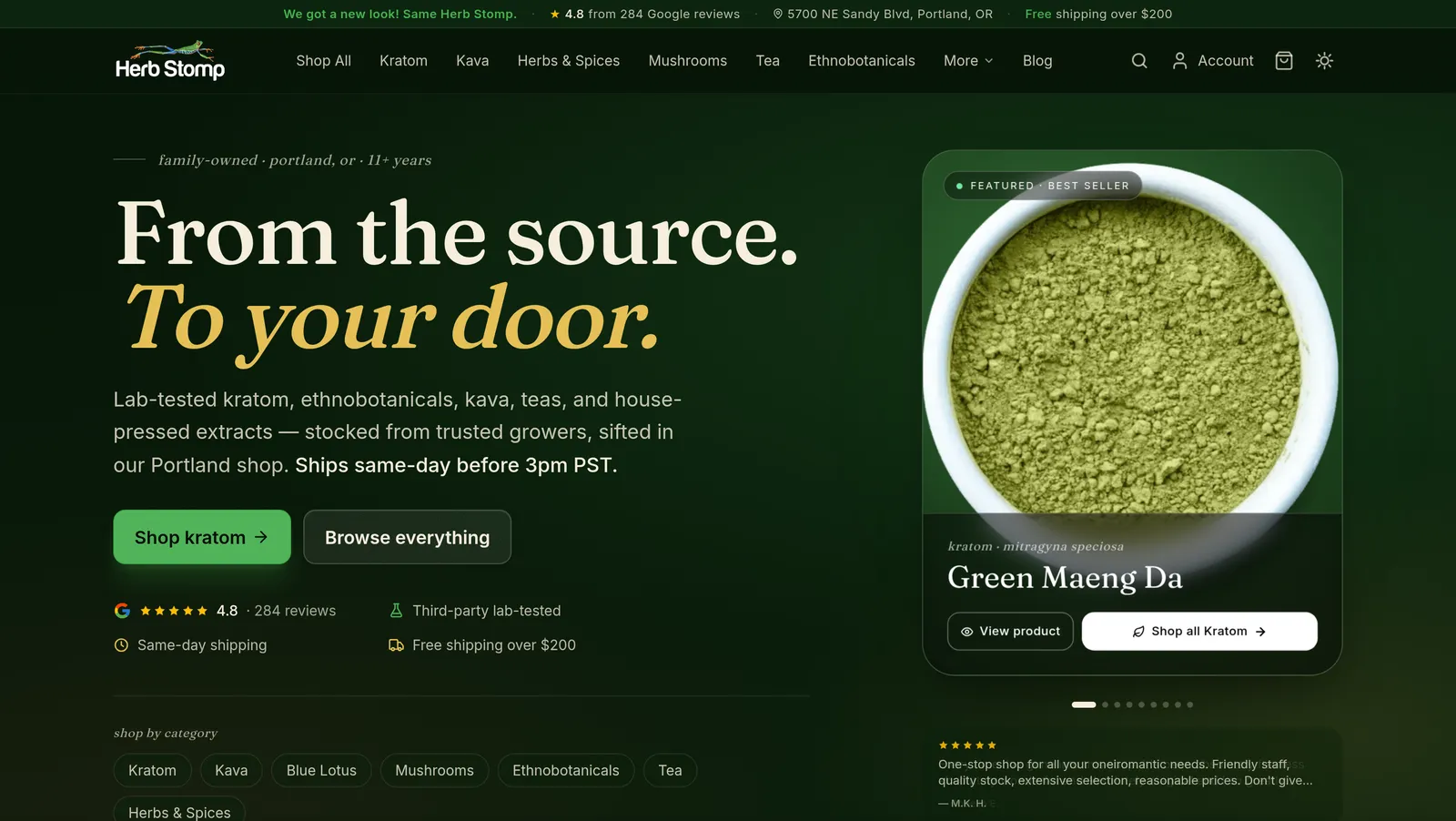
Herb Stomp is a family-owned Portland botanicals shop selling products people research for an hour before they buy, in a category where one wrong claim can lose you your payment processor. Most stores react by stripping their pages to nothing, which kills the SEO and the sales at the same time. We did the opposite: real category and product copy, 37 researched guides, and clean schema on every page, all inside compliance framing built into the template.
Google Search Console recorded 1,508 clicks in the first 28-day window and 3,166 in the latest. Google Analytics recorded 125% more organic search sessions. Jun 28–Jul 25 vs. Aug 23–Sep 19, 2026. Read the dated results and growth chart.
Researched guides, each wired to the products it mentions
Kratom strains, filterable, on category pages that carry real copy
Product, Breadcrumb, and FAQ schema across the catalog
A real reputation to build the rankings on
Guides that rank, wired to the products they sell.
Ecommerce SEO for a store like this isn't just product pages. It's the informational searches around every plant, the "what is damiana" and "kava vs kratom" queries people run before they ever look to buy. So each of the 37 guides targets one of those searches, and pins a "Products in this guide" panel right next to the article. The reader who came for the answer never has to go hunting for the product.
The ongoing SEO program is bringing more readers into that store. Google clicks more than doubled between the measured 28-day windows, with gains on the Wild Dagga guide, the kratom category, and the Amanita product page. We keep refining the category copy, expanding the guides, and connecting the answers people find to the products they can buy.
Four fixes that show up on almost every ecommerce SEO engagement.
The work itself isn't mysterious. Most of it is small surgical changes at the template level that the platform's default theme didn't bother with. Here's what these actually look like in code.
# robots.txt — block crawl-budget-burning parameters
User-agent: *
Disallow: /*?orderby=
Disallow: /*?filter_*
Disallow: /*?paged=

<!-- canonical to parent category on filter URLs -->
<link rel="canonical" href="https://store.com/collections/coffee/"><!-- Product JSON-LD with Offer + AggregateRating -->
<script type="application/ld+json">
{
"@type": "Product",
"name": "Cold Brew Concentrate · 32oz",
"sku": "CB-32",
"offers": {
"@type": "Offer",
"price": "24.99",
"priceCurrency": "USD",
"availability": "https://schema.org/InStock"
},
"aggregateRating": {
"@type": "AggregateRating",
"ratingValue": "4.7",
"reviewCount": "312"
}
}
</script># Permanent discontinuation: 301 to parent category
location ~ ^/products/cold-brew-summer-2024$ {
return 301 /collections/cold-brew/;
}
<!-- Temporary out of stock: keep URL, flip availability -->
"availability": "https://schema.org/OutOfStock",
"itemCondition": "https://schema.org/NewCondition"<!-- Buying guide funnels authority to category + key PDPs -->
<p>Browse our full <a href="/collections/cold-brew/">cold brew collection</a>
or jump to the bestseller, the
<a href="/products/cold-brew-32oz/">32oz concentrate</a>.</p>
<!-- Category page links to subcategories + featured PDPs -->
<nav class="category-quick-links">
<a href="/collections/cold-brew-single-origin/">Single Origin</a>
<a href="/collections/cold-brew-blends/">Blends</a>
</nav>The same technical SEO that scaled fintech and telehealth, applied to your store.
Two engagements where we diagnosed the platform-level technical issue most agencies miss. The work that produced these outcomes is the same work we run on Shopify, WooCommerce, and headless commerce engagements.
LifeMD
100×
Keyword growth
7 mo
Engagement length
A 7-month technical SEO consulting engagement that diagnosed a Craft CMS rendering bug blocking Google from indexing LifeMD's content. The same JS-rendering audit applies to ecommerce stores running React or Vue front ends.
View case studyCredit Sesame
$5.5M+
Cumulative traffic value
22 mo
Engagement length
22-month engagement that took a Silicon Valley fintech to top 5 for "free credit score" against Experian, Equifax, and TransUnion. The same competitive technical SEO playbook works for ecommerce categories where Amazon and category-killer marketplaces dominate.
View case studyYour next customer is asking ChatGPT what to buy.
More shoppers start in an AI answer now, not a results page. They ask ChatGPT for "the best option for my situation," they read Google's AI Overview, they let Perplexity compare two products before they ever click a store. If your catalog isn't structured for those systems to read and cite, you're invisible at the exact moment the decision gets made.
The good news: the work that earns those citations is the same technical ecommerce SEO work that ranks. Clean, valid Product and Offer schema so an AI can pull your price, availability, and rating without guessing. Real product copy instead of the manufacturer boilerplate every competitor also pasted in. Category and comparison content written the way people actually ask the question. FAQ schema that answers the follow-ups. Do that, and you become the source the AI quotes instead of the store it skips.
We build this in from the start, at the template level, so it holds across the whole catalog instead of a handful of hero products. It's the same approach that gets our clients' pages cited in AI Overviews today, and the same reason Herb Stomp's 37 guides are structured to answer the questions shoppers ask before they buy. More on how we optimize for AI search.
The seven questions store owners ask.
What does technical ecommerce SEO actually fix?
Six things in order of impact for most stores. Indexation: filter URLs eating crawl budget while real product pages stay uncrawled. Schema: product markup that doesn't validate or pulls wrong data. Core Web Vitals: theme bloat dragging LCP and INP into the red. Faceted nav: no canonical or robots strategy across millions of filter combinations. Out-of-stock handling: discontinued products 404'ing instead of redirecting and bleeding link equity. Internal linking: authority concentrated on /collections/ instead of distributed to PDPs. Most ecommerce SEO programs that stall do so because one or more of these never gets fixed.
Why does Savo Group not have a 'pure ecommerce' case study front and center?
Honest answer: our public case studies lean toward FinTech (Credit Sesame, $5.5M traffic value), telehealth (LifeMD, 100× keyword growth from a Craft CMS rendering fix), enterprise SaaS (iovation, FindLaw, Salem Web Network at 52M monthly pageviews), and large content networks. The technical SEO work that produced those outcomes — schema, indexation, JS rendering, internal linking, migration safety — is the same work that drives ecommerce SEO. We bring it to Shopify, WooCommerce, and headless commerce stores when they engage us.
Should I migrate off Shopify or WooCommerce to rank better?
Probably not. Stock Shopify and stock WooCommerce both rank fine for the majority of stores when configured properly. The migration question only kicks in when the platform itself is the ceiling: speed targets a stock theme can't hit, design or layout requirements that aren't expressible in Liquid or PHP templates, or schema and SEO control needs that demand template-level access. We'll tell you straight which side of the line you're on. Migration without losing rankings is a real engagement; migrating because it's trendy isn't worth it.
How does Savo Group handle faceted navigation?
Different strategy per store, but the principles are the same. Crawl-budget-burning filters get blocked via robots.txt or noindexed at template level. SEO-valuable filter combinations (color, size, brand on a category page) get canonicalized to the parent category. Parameter-based URLs use the rel=canonical approach with parameters preserved client-side for the user. The implementation depends on the platform — Shopify needs Liquid + theme work, Woo needs plugin or function-level config, headless gets configured cleanly at the route level.
How long until rankings move on an ecommerce SEO engagement?
Crawl and indexation fixes typically show movement in weeks two through six because they unblock pages Google was already trying to crawl. Schema and Core Web Vitals fixes compound over the first quarter. Content and authority work compounds over months three through nine. Google's own SEO Starter Guide notes that ranking changes take time to surface. We track against monthly baseline so the deltas are visible from the first report.
Can you SEO a store on BigCommerce, Squarespace Commerce, or Wix?
BigCommerce: yes, similar playbook to Shopify. Squarespace and Wix: technically yes, practically limited. Both platforms throttle the technical work that matters most (schema control, robots configuration, template-level changes). If you're already on either, we'll tell you whether the SEO ceiling is high enough for your goals or whether a platform migration to Shopify, WooCommerce, or headless commerce is the right call before any SEO budget gets spent.
Do you ship the schema yourself or hand it to my dev team?
We ship it. The technical work is the work. Most ecommerce SEO agencies hand you a 60-page audit and tell you to give it to your developer. We have an in-house engineering team, so when an audit identifies broken schema, missing canonicals, or a JS-rendering issue, the same engagement that diagnosed it ships the fix. If your platform itself is the bottleneck, we can rebuild the front end as headless without losing rankings.
Ready to Grow Your Business?
Hand-coded websites and real SEO from a family-owned team with 27 years of experience. From small local businesses to enterprise corporations, nationwide.
Custom Websites That Convert
Hand-coded from scratch. No WordPress, no templates, no page builders. Your site loads in under a second, has nothing to hack, and is built to turn visitors into calls and form fills. Pretty is the floor, not the point.
Custom websites
Scoped to what you actually need. We look at the project and give you a straight quote. No packages, no upsells.
PageSpeed
100
Load Time
0.6s
Plugins
0
Core Web Vitals
SEO That Actually Moves Rankings
Content, links, technical audits, and AI search optimization. We move rankings and tie the work to real leads, not vanity traffic charts. Every SEO client gets Persilio, our lead management platform, free.
SEO
Pricing based on your location(s), competition, and industry. We'll assess your market and give you a straight answer.
- Local SEO + Google Business Profile
- Content + link building
- AI SEO / GEO optimization
What's Included
Persilio lead tracking, included free
Lead Tracking & Management
Web design and SEO is where most agencies stop. We built Persilio, our own lead management platform and mobile app, so every call and form from your site lands in one place. It comes free with every SEO plan.
Persilio, free for SEO clients
No per-seat fees, no add-on cost. If we run your SEO, you get the platform and the app, included.
- Calls and form fills captured automatically
- iOS and Android app with instant alerts
- Reporting that ties rankings to real business
What You Get
Free with every SEO plan
Prefer to just talk? (360) 838-6304 · Book a call · Mon-Fri, 9am-6pm PST