Custom Ecommerce Web Design Without the Theme Bloat
We build Shopify and WooCommerce stores from scratch and keep them lean. Fewer plugins means your store loads fast, ranks better, and doesn't break the week before your biggest sale. Design, engineering, and SEO come from one team, so nothing gets lost in a handoff.



We'll show you what's costing you sales.
Send your store URL. We'll review Core Web Vitals, app stack, PDP design, mobile flow, checkout friction, and trust signals. Real findings inside 48 hours.


Fifteen minutes, not a sales deck.
Tell us your platform, your conversion targets, and where the build is stuck. We'll tell you what we'd ship and what it costs. No SDR.


"Best business decision I've ever made! Got ranked #1 in my area super fast and calls started coming in left and right. I guarantee you will make your ROI in no time and the team is very responsive and helpful."
"Michael is an expert at technical SEO who can align both product/business goals with organic traffic increases. He not only brings traffic but relevant converting traffic to the sites he works on."

"I can't say enough good things about these guys! Amazing company and I'll continue to refer them to everyone I know!"

"Michael delivered everything he promised and more. He has been responsive to our requests and intuitive about our needs. I highly recommend Michael for your web design and SEO needs."

"We contracted with Michael to develop a series of websites concentrating on attorney marketing and the results have far exceeded expectations. Their results-oriented approach to marketing services delivers a strong return on investment."

Every second you wait, more buyers leave.
Bounce rate climbs steeply as mobile load time increases. The data is from Google's own field studies, not vendor marketing. Every ecommerce design decision lives downstream of this curve.
A page that takes 6 seconds to load is more than twice as likely to lose the visitor as one that loads in 1 second. On stock Shopify with a typical app stack, mobile load times of 4–7 seconds are common. The speed budget on every Savo Group ecommerce build is sub-2-second LCP across templates.
Most stores ship with 20+ apps. Most of them are theater.
Eight categories where Shopify and WooCommerce stores accumulate apps that add load time without adding revenue. The verdict column is what we typically do during a Savo Group ecommerce build audit.
App removed entirely. The function it provided wasn't earning its load-time cost.
Function valuable, app implementation is bloat. We rebuild it directly into the theme.
Keep the one tool that's earning revenue. Cut the redundant or dormant ones.
Ready to Grow Your Business?
Hand-coded websites and real SEO from a family-owned team with 27 years of experience. From small local businesses to enterprise corporations, nationwide.
Custom Websites That Convert
Hand-coded from scratch. No WordPress, no templates, no page builders. Your site loads in under a second, has nothing to hack, and is built to turn visitors into calls and form fills. Pretty is the floor, not the point.
Custom websites
Scoped to what you actually need. We look at the project and give you a straight quote. No packages, no upsells.
PageSpeed
100
Load Time
0.6s
Plugins
0
Core Web Vitals
SEO That Actually Moves Rankings
Content, links, technical audits, and AI search optimization. We move rankings and tie the work to real leads, not vanity traffic charts. Every SEO client gets Persilio, our lead management platform, free.
SEO
Pricing based on your location(s), competition, and industry. We'll assess your market and give you a straight answer.
- Local SEO + Google Business Profile
- Content + link building
- AI SEO / GEO optimization
What's Included
Persilio lead tracking, included free
Lead Tracking & Management
Web design and SEO is where most agencies stop. We built Persilio, our own lead management platform and mobile app, so every call and form from your site lands in one place. It comes free with every SEO plan.
Persilio, free for SEO clients
No per-seat fees, no add-on cost. If we run your SEO, you get the platform and the app, included.
- Calls and form fills captured automatically
- iOS and Android app with instant alerts
- Reporting that ties rankings to real business
What You Get
Free with every SEO plan
Prefer to just talk? (360) 838-6304 · Book a call · Mon-Fri, 9am-6pm PST
Four differences between a Savo Group ecommerce build and a theme with your logo on it.
One
Design from concept, not from a theme's bones.
Most "custom" Shopify or WooCommerce builds start by buying a $300 theme and customizing colors, fonts, and a hero image. The PDP layout, the cart drawer, the checkout step order, the typography hierarchy — all of it is inherited from the theme. Two stores that bought the same theme can be told apart only by their logos.
We design from your brand. The PDP layout is built around what your buyer needs to decide. The cart drawer is engineered for your AOV math. The category page is structured around the way buyers in your category actually browse. Custom code, not custom skin.
Two
App audit is the build, not an afterthought.
Most ecommerce designs ship with whatever app stack the client already runs. We assume nothing. Every app gets reviewed against three questions: Is the function valuable? Does this app earn its load-time cost? Can the function be rebuilt into the theme directly with less drag?
Reviews and email-capture stay if there's a real engineering reason. Page builders, popup apps, and most upsell apps get cut. Wishlist, trust badges, and cross-sell get rebuilt into the theme. The result is typically a 15-app reduction with zero feature loss.
Three
Schema applied at template level, not via app.
Default Shopify and WooCommerce schema is incomplete or invalid on most stores. Reviews schema gets injected by an app and conflicts with the theme's own. Product schema is missing required properties or pulls wrong data. Google catches the mismatch and quietly stops showing rich results.
We apply Product, Offer, AggregateRating, BreadcrumbList, and FAQPage schema directly in the Liquid or PHP template. Once. Validated. Pulling from the canonical product data. No third-party app injecting conflicting markup.
Four
Performance budget enforced from day one.
Most ecommerce designs treat performance as a post-launch fix. The build ships at 38 mobile PageSpeed and the optimization phase tries to claw back fifteen points. By then the theme architecture, the app stack, and the layout decisions have all locked in the ceiling.
Every Savo Group ecommerce build sets a sub-2-second LCP budget across templates from the kickoff. Image optimization, font subsetting, lazy loading, and async script loading are baked in from the first commit. The build doesn't ship if it doesn't meet the budget.
Everything above, on one real store.
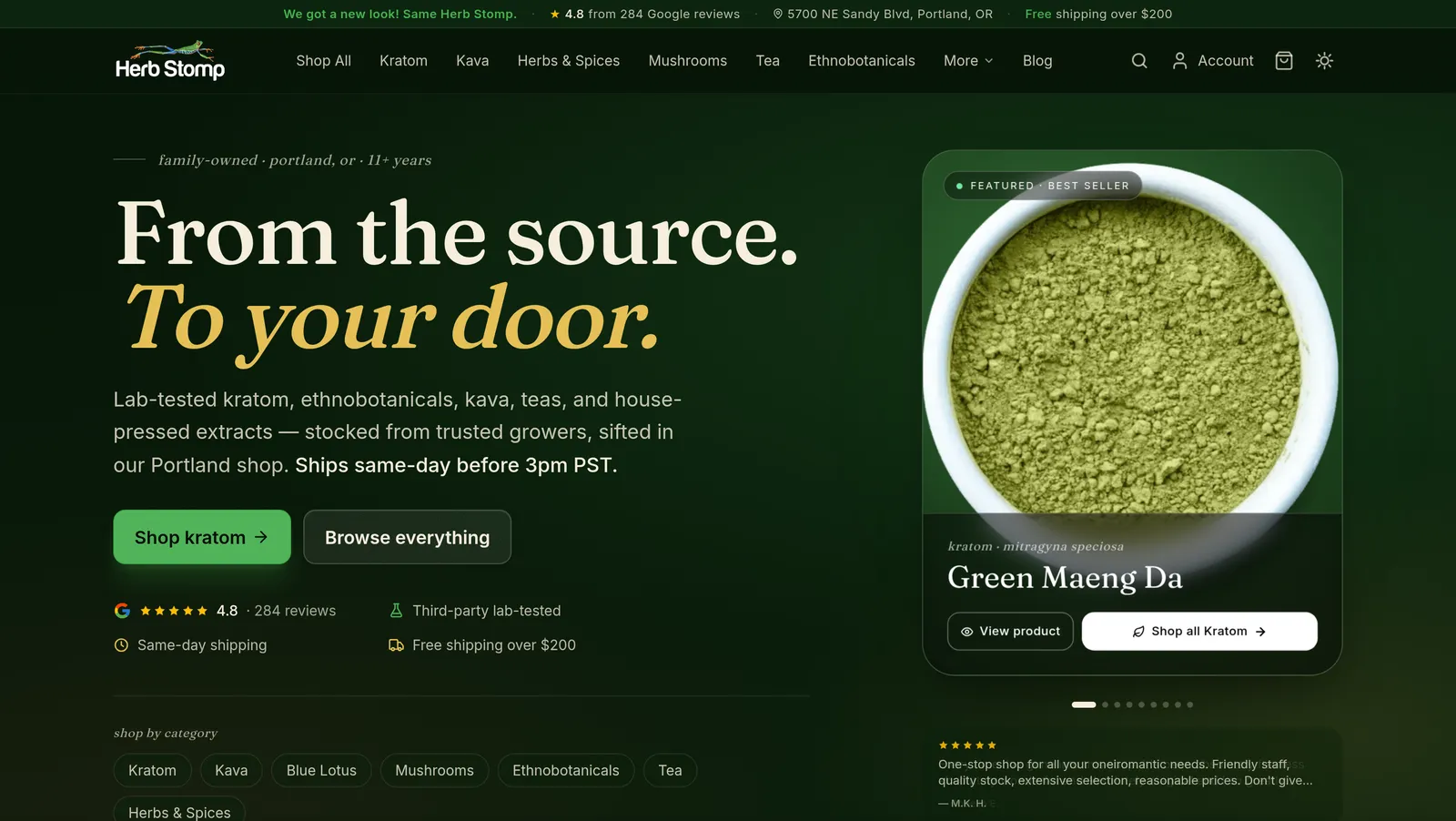
Herb Stomp is a family-owned Portland botanicals shop, 11 years on NE Sandy, 4.8 stars across 284 Google reviews. They were running the same stock WooCommerce theme half their category runs. We rebuilt the storefront on custom Astro with a headless WooCommerce backend, so the catalog and orders stay where their team already works while the front end is fast, hand-coded, and app-light.
The blog sells, on purpose
Every guide pins a "Products in this guide" panel next to the article. The moment a reader is convinced, the product is one click away instead of buried in the nav. No dead-end content.
The buy button never leaves
Products people research get long write-ups, which usually shoves Add to Cart below the fold. Here the buy box is a sticky column, so the product stays buyable at every scroll position.
Four phases. Six to ten weeks. What ships in each one.
Stakeholder interviews. Audit of current store including app stack, theme, and Core Web Vitals baseline. Brand and competitive research, then visual design direction with two concept rounds. Template inventory locked. Conversion benchmarks captured per page type so we measure post-launch deltas against real numbers.
Final designs across templates. Custom Liquid (Shopify) or PHP (Woo) theme development. PDP layouts tuned to your category. PLP and category page architecture. Cart drawer or page. Checkout-adjacent pages. App audit list locked: what stays, what gets cut, what gets rebuilt into the theme.
Schema markup applied at template level. Image optimization, font subsetting, lazy loading. App audit executed: cut bloat, rebuild essentials into the theme, keep only the apps earning their cost. Core Web Vitals tested across templates against real-world mobile conditions, not lab data only.
Cross-browser and device QA. Data migration if applicable. URL-by-URL 301 redirect mapping. Staging review with the full team. Cutover at low-traffic window. Search Console monitoring. 404 log review for the first 60 days. Conversion rate, Core Web Vitals, and ranking deltas tracked against the pre-launch baseline.
The seven questions store owners ask.
What's actually different about a custom ecommerce build vs a Shopify theme?
Four things, all real. Design is custom from concept, not a theme variation. We build mockups against your brand, not against a theme's bones. App audit is part of the build, not an afterthought. We audit the full app stack, kill what's bloat, rebuild what's essential into the theme directly. Schema is applied at template level, not bolted on by a third-party app. Performance is enforced from day one with a sub-second mobile budget on every template, validated in real-world conditions, not lab data only.
How much does a custom ecommerce build cost?
Custom-quoted per project. The variables are catalog size, template count, integration complexity (subscriptions, B2B portals, ERP, custom checkout), and migration scope. Most stock Shopify or WooCommerce custom builds run between 6 and 10 weeks. Headless rebuilds run 10 to 16. We give a real number after a feasibility audit, not before. We don't publish ecommerce build pricing because it varies too widely to be honest about.
Will my apps and integrations still work?
The ones that earn their cost, yes. The app audit is part of the build. Some apps stay (review platforms with real schema integration, email tools your team already runs on). Some get cut (most popups, most upsell apps, most trust-badge apps that just inject scripts). Some get rebuilt directly into the theme so the function is preserved without the page-load cost. We name every app and explain the call before any of it ships.
How is this different from your headless web design service?
Custom theme on stock platform vs a full headless rebuild. Most of the time, a custom Shopify or WooCommerce theme does the job: faster than the stock theme, cleaner schema, better PDP design, fewer apps. Headless only kicks in when the platform itself is the speed or design ceiling. We turn down headless requests when stock platform is fine. Our feasibility audit tells you which side of the line you're on.
Can you do checkout customization on Shopify?
Within Shopify's rules. Shopify Plus stores have full Checkout Extensibility (UI extensions, post-purchase pages, customizable thank-you flows). Non-Plus stores are limited to Shopify's standard checkout but can still customize cart, post-purchase, and accounts. We'll tell you what's possible based on your Shopify tier before scoping work. WooCommerce has fewer guardrails, so checkout customization is more flexible there.
Will my SEO survive the rebuild?
Yes when the migration is run properly. Pre-launch crawl baseline so we know what's ranking. URL-by-URL 301 redirect map validated in staging. Schema and canonical preservation across templates. 60 days of 404-log monitoring post-launch. Google's official site-move guidance is the foundation. The technical work is part of the engagement, not an extra service.
Do you also handle ecommerce SEO and ongoing optimization?
Yes. Our ecommerce SEO services run alongside or after the build. The technical foundation we ship — schema, canonicals, URL structure, Core Web Vitals — is what ecommerce SEO compounds on.
Ready to Grow Your Business?
Hand-coded websites and real SEO from a family-owned team with 27 years of experience. From small local businesses to enterprise corporations, nationwide.
Custom Websites That Convert
Hand-coded from scratch. No WordPress, no templates, no page builders. Your site loads in under a second, has nothing to hack, and is built to turn visitors into calls and form fills. Pretty is the floor, not the point.
Custom websites
Scoped to what you actually need. We look at the project and give you a straight quote. No packages, no upsells.
PageSpeed
100
Load Time
0.6s
Plugins
0
Core Web Vitals
SEO That Actually Moves Rankings
Content, links, technical audits, and AI search optimization. We move rankings and tie the work to real leads, not vanity traffic charts. Every SEO client gets Persilio, our lead management platform, free.
SEO
Pricing based on your location(s), competition, and industry. We'll assess your market and give you a straight answer.
- Local SEO + Google Business Profile
- Content + link building
- AI SEO / GEO optimization
What's Included
Persilio lead tracking, included free
Lead Tracking & Management
Web design and SEO is where most agencies stop. We built Persilio, our own lead management platform and mobile app, so every call and form from your site lands in one place. It comes free with every SEO plan.
Persilio, free for SEO clients
No per-seat fees, no add-on cost. If we run your SEO, you get the platform and the app, included.
- Calls and form fills captured automatically
- iOS and Android app with instant alerts
- Reporting that ties rankings to real business
What You Get
Free with every SEO plan
Prefer to just talk? (360) 838-6304 · Book a call · Mon-Fri, 9am-6pm PST